

Where does Nottinghamshire’s £240 million go?
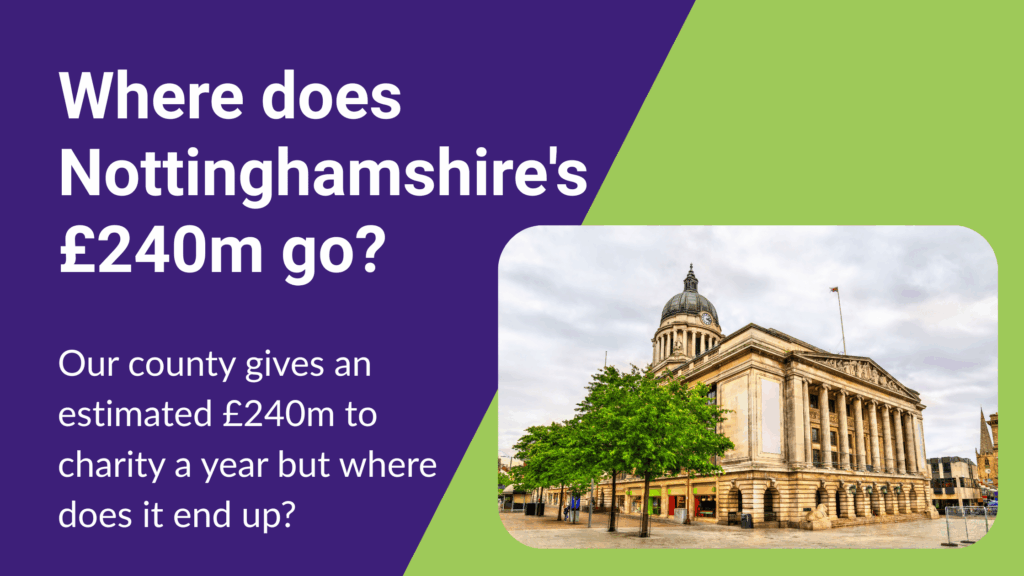
Britons gave £14 billion to charity last year. Scale that across Nottinghamshire and the county’s share is around £240 million. The question worth asking is, how much of it stays here?
The Charities Aid Foundation published its UK Local Giving Report 2026 last week. One headline stands out: the UK public donated an estimated £14 billion to charity in 2025, down from £15.4 billion the year before. On average, people are now giving 0.9% of their income to charity, a fall from 1.1% in 2024.
Nottinghamshire is home to around 1.2 million people, roughly 1.7% of the UK population. Applied evenly, the county’s share of that £14 billion would be in the order of £240 million flowing out of household budgets each year. That is real money, generated in Nottingham, Mansfield, Newark, Worksop and every village in between.
So where does it go?
The shape of UK charity
The honest answer is that most of it goes to a small number of very large organisations. There are around 171,000 registered charities in the UK. According to the National Council for Voluntary Organisations, the 4% of charities with annual incomes above £1 million account for roughly 96% of all charity income and spending. At the other end, the 80% of charities with incomes under £100,000 account for just 3%.
That is not a criticism of the big national charities. They do important work, they have professional fundraising operations, and they have spent decades building brand recognition. When a donor reaches for the most familiar name, the system is working as designed.
But it is worth pausing on what that pattern means for a county like ours. If hundreds of millions of pounds leave Nottinghamshire households each year and the majority of it heads to national head offices, only a portion finds its way back to local causes. The food bank in Hyson Green, the youth project in Worksop, the carers’ group in Rushcliffe: these are the organisations Nottinghamshire’s own residents most often want to support, but they are competing for attention with fundraising operations many times the size of their entire annual budget.
What the CAF report actually shows
The Local Giving Report makes this gap explicit. Across the East Midlands, only 43% of people feel that charities have had a positive impact in their area. That is the lowest figure of any region in the UK. The South East sits at 55%, the South West at 56%, Northern Ireland at 56%.
The East Midlands is not less generous. The proportion of income donated locally (0.87%) is roughly in line with the UK average of 0.9%. People here give. They just struggle to see the local effect of their giving.
That matters, because the same report shows a clear pattern: when people can see the positive impact of charities in their community, they are much more likely to donate overall, twice as likely to give locally, and three times as likely to volunteer. Visibility unlocks generosity. Invisibility suppresses it.
A question worth asking
Three questions a donor might fairly ask of any cause:
- Can you trace where the money goes?
- Is the work it funds genuinely needed?
- Does it strengthen the people and places I love?
These are not awkward questions. They are the same questions a thoughtful person asks of any significant purchase. Applied to charitable giving, they tend to favour local, visible, accountable work over national, abstract, professionalised work. That is not because the second category is bad, but because the first category is easier to verify.
What Forever Notts does
“Nottinghamshire is a generous county. People here give, and they give consistently. What this report shows is that they are not always seeing the difference their generosity makes on their own doorstep. That is the gap community foundations were built to close. At Forever Notts, every fund we hold stays in the county, every grant goes to a Nottinghamshire cause, and every donor knows where their money has gone and what it has changed. That is what local giving looks like when it is done properly.”
Nina Dauban, Chief Executive, Forever Notts
Forever Notts is Nottinghamshire’s community foundation. It pools donations from local people, families, professional advisors and businesses, and channels them into grants that stay in the county. Every fund set up with Forever Notts directs 100% of its giving to Nottinghamshire causes. Donors choose the theme, whether that is mental health, homelessness, older people, young people or belonging, and the foundation does the work of finding the local organisations doing the most credible work in that area.
In nearly thirty years, Forever Notts has directed more than £30 million in small grants to Nottinghamshire charities and community groups. That is a fraction of what the county sends to charity each year. This article is not arguing that local giving should replace national giving. The point is simpler: for a city and county whose residents collectively donate hundreds of millions of pounds to charity each year, much of which never returns, it is worth knowing that a fully local alternative exists.
If you are a Nottinghamshire resident, a professional advisor with clients who care about their legacy, or a business considering where to direct its giving, the CAF report shows the county already gives. The question is, how much of that giving you would like to see stay here?
If you would like to talk to us for free advice about setting up a charitable fund, donating to a local cause or leaving a legacy, please email en*******@**********ts.com or contact us.
Charity no. 1069538
The CAF UK Local Giving Report 2026 is available at cafonline.org.
Sources and figures used
- £14 billion donated by the UK public in 2025, down from £15.4 billion in 2024: CAF UK Giving Report 2026 (published March 2026)
- 0.9% of income donated, down from 1.1%: CAF UK Local Giving Report 2026 (published May 2026)
- East Midlands 43% positive impact figure (lowest of any UK region) and 0.87% of income donated locally: CAF UK Local Giving Report 2026
- “Twice as likely to give locally” and “three times as likely to volunteer”: CAF UK Local Giving Report 2026, as summarised by UK Community Foundations, 20 May 2026
- Around 171,000 UK registered charities at end of 2025: Charity Commission register data, reported by Civil Society Media, January 2026
- 4% of charities (income above £1m) account for ~96% of sector income and spending; 80% of charities (income under £100k) account for ~3%: NCVO UK Civil Society Almanac 2024, based on 2021/22 financial data (latest available)
- Nottinghamshire ceremonial county population ~1.2 million in 2024: ONS mid-year estimates, combining Nottinghamshire County (~870k) and Nottingham City (331,077)
- £240 million county figure: 1.7% of £14 billion UK total. This is an even-distribution estimate; the actual figure for Nottinghamshire specifically is not published, but is likely close given that East Midlands gives 0.87% of income (just below the UK average of 0.9%)